Running workloads across on-premises servers and the public cloud sounds simple until unexpected server costs or a compliance gap surface during an audit. This is usually the result of two disconnected environments with separate tooling, separate server security policies, and no unified visibility into where data resides. A well-planned hybrid cloud architecture fixes this by connecting private and public infrastructure into one coordinated system.
This article explains what hybrid cloud architecture is, the components and design principles behind it, and how to build, secure, and scale one in production.
What Is Hybrid Cloud Architecture?
Hybrid cloud architecture is the design and structure that connects private infrastructure, such as an on-premises data center or private cloud, with one or more public cloud environments. The architecture defines how these environments communicate, share data, and run workloads as a single coordinated system rather than as isolated systems.
The private side runs on owned or leased hardware, keeping the workloads under the organization’s direct control over configuration, compliance, and data placement. The public side is where the benefit of hybrid cloud shows up: the infrastructure owned and maintained by a cloud provider supplies the elastic capacity for new application development, broader reach, and a wide range of managed services that private infrastructure alone cannot match.
Hybrid cloud differs from a multi-cloud architecture, which combines multiple public clouds without a private infrastructure component. It also differs from a simple lift-and-shift cloud migration, where workloads move to the cloud without ongoing integration back to on-premises systems.
Hybrid cloud architecture assumes both the private and public environments stay in active, ongoing use. Container platforms such as Kubernetes and cloud virtualization layers make that sustained dual use practical, allowing the same workload definitions to run on either side without being rebuilt for each environment.
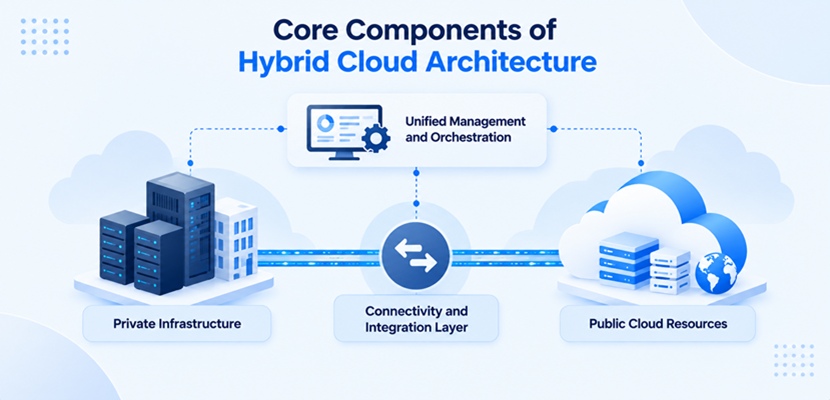
Core Components of Hybrid Cloud Architecture
Four core layers work together to make a hybrid cloud architecture function: private infrastructure, public cloud resources, the connectivity that links them, and the management layer that runs both as one coordinated system. Removing any single layer breaks the coordination that makes a hybrid design useful.
Private Infrastructure
The private side of a hybrid architecture includes on-premises data centers, physical and dedicated servers, private cloud platforms, and colocation hosting. This infrastructure runs on hardware the organization owns, leases, or fully controls, which keeps regulated or latency-sensitive server workloads under direct oversight.
Because the organization manages the environment end to end, private infrastructure sets the baseline for compliance and data residency requirements the rest of the architecture needs to accommodate.
Organizations that want dedicated physical servers without owning and maintaining the hardware can use phoenixNAP Bare Metal Cloud (BMC). BMC provisions single-tenant servers on demand through the BMC API, which combines the control of dedicated hardware with the flexibility of a cloud-based deployment model.
Public Cloud Resources
Public cloud resources supply the elastic capacity a hybrid architecture uses for scaling when demand outgrows what private infrastructure can handle. Public cloud providers offer compute, data storage, and managed services (databases, AI/ML platforms, content delivery). This allows organizations to support new application development without provisioning hardware for it first and offload specialized services they’d rather not build or maintain themselves.
Organizations with unpredictable or seasonal demand rely on this elasticity to scale up without over-provisioning private infrastructure. Public cloud also provides global reach as organizations can lower latency by running workloads closer to end users and achieve compliance more easily in regions with data residency rules in regions where they have no private footprint.
Connectivity and Integration Layer
Private infrastructure and public cloud resources need a reliable link to function as one architecture instead of two disconnected systems.
This layer includes the network paths, application programming interfaces (APIs), and data-transfer mechanisms that let workloads and information move between environments. It also handles identity federation, typically through a single identity provider using standards like SAML or OICD, so users and applications authenticate consistently regardless of where a workload runs.
Unified Management and Orchestration
A hybrid architecture needs one operational view across both environments, not two dashboards and two workflows.
Unified management tools handle provisioning, monitoring, and policy enforcement across private and public infrastructure from a single control point, while teams often provision infrastructure with Terraform to keep environment setup consistent. Orchestration platforms, including Kubernetes for hybrid deployment, schedule workloads while additional management and configuration tools can help maintain consistency across environments.
How Hybrid Cloud Architecture Works
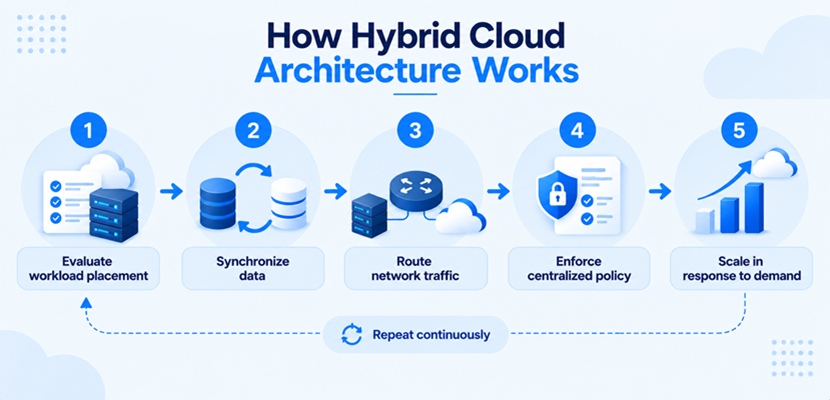
Hybrid cloud architecture functions as a continuous process, not a one-time setup. Once the components are in place, the architecture routes workloads, synchronizes data, and enforces policy based on rules the organization defines. That process repeats every time a workload runs, scales, or needs to move.
The typical flow includes:
- Evaluating workload placement. The orchestration layer checks a workload's compliance requirements, latency sensitivity, and resource needs, then assigns it to private infrastructure or public cloud accordingly.
- Synchronizing data. Data required by both environments is replicated or synced across the connectivity layer, keeping information consistent regardless of where processing happens.
- Routing network traffic. Requests move between environments through the established network paths, using consistent identity and access controls on both sides.
- Enforcing centralized policy. The management layer applies the same access rules, security patch schedules, and configuration standards to workloads in both environments, rather than maintaining separate rule sets.
- Scaling in response to demand. As demand rises, the architecture automatically shifts additional load to the public cloud, temporarily expanding capacity beyond what private infrastructure alone provides, then scales back down once demand drops.
This cycle repeats continuously, which lets the architecture adapt to changing workloads without manual reconfiguration each time.
Key Design Principles for Hybrid Cloud Architecture
Designing hybrid cloud architecture properly depends on the principles guiding it, not only the technology involved. These principles shape how organizations make decisions about workload placement, governance, and long-term maintainability before a single component gets deployed.
The following principles apply across most hybrid environments, regardless of provider.
Workload Portability
Portability prevents a hybrid architecture from becoming a one-way migration path, where applications move to the cloud but can never move back. Workloads should run without depending on features specific to one environment. Using containers, standard APIs, and infrastructure-as-code templates keeps applications movable between private and public infrastructure.
Consistent Governance
A hybrid architecture needs one set of policies for identity, access, and compliance, applied the same way in both environments. Split governance, where private infrastructure and public cloud follow different rules, creates gaps that are hard to audit and easy to exploit. Centralized governance keeps policy enforcement predictable as the architecture grows.
Security Integrated by Design
Security controls belong in the architecture from the first design decision. Retrofitting encryption, access controls, or network segmentation onto a live environment costs more and leaves gaps attackers can exploit before fixes are made. Building these controls into the initial design means every new connection between private and public infrastructure inherits the same baseline protections automatically.
Cost Visibility
Every workload placement decision carries a data center cost tradeoff between owned infrastructure and consumption-based cloud computing pricing. Designing for cost visibility means tracking spend by workload and environment from the start. This way, placement decisions stay based on data rather than assumptions.
Resilience Through Isolation
A well-designed hybrid architecture limits how far a failure in one environment spreads into the other. Isolating fault domains achieves this by keeping backup capacity separate from primary workloads. Then, a public cloud outage cannot take down on-premises operations, and an on-premises failure cannot take down the cloud side.
Networking in Hybrid Cloud Architecture
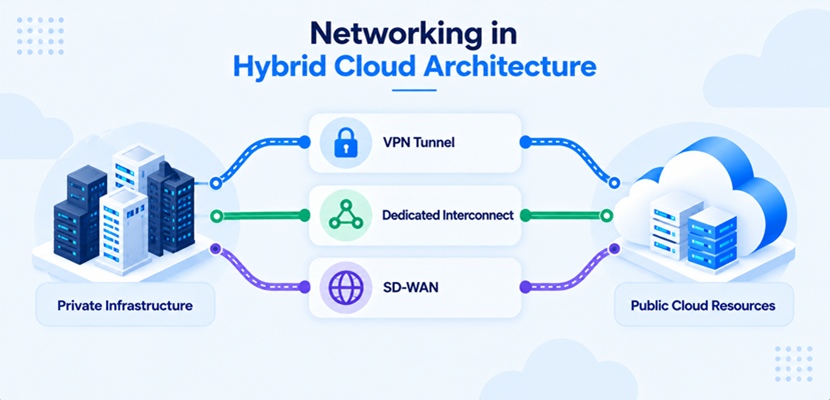
Networking connects the private and public sides of a hybrid architecture at the packet level, not just conceptually. The connectivity choices directly affect latency, security, and how reliably applications can move between environments.
Organizations connect environments through:
- Virtual Private Network (VPN) tunnels. Encrypted connections over the public internet link private infrastructure to a cloud provider's network, offering a low-cost option for moderate traffic volumes.
- Dedicated interconnects. A private, physical connection to the cloud provider bypasses the public internet entirely, reducing latency and improving reliability for high-throughput workloads.
- Software-defined Wide Area Networking (SD-WAN). This approach manages traffic across multiple connection types, routing each workload through the most appropriate path based on current conditions.
Network latency and bandwidth planning matter as much as the connection type itself. Workloads that depend on frequent, low-latency communication between environments need a dedicated interconnect or a carefully tuned SD-WAN path, since a standard VPN tunnel can introduce delays that degrade performance. Consistent domain name system (DNS) records and service discovery across both environments let applications find and reach services regardless of where those services run.
Security Considerations in Hybrid Cloud Architecture
Security in a hybrid environment has to account for two different infrastructure models under a single, consistent policy. Attackers look for the gaps that appear when teams secure private and public environments separately instead of as one system.
Core security considerations include:
- Unified identity and access management. A single identity provider authenticates users and services across both environments, avoiding the risk of separate account systems falling out of sync.
- Data encryption in transit and at rest. Data moving across the connectivity layer, and data stored in either environment, should use encryption that meets the same standard on both sides.
- Network segmentation. Isolating workloads by sensitivity level limits how far a breach in one segment spreads, whether that segment sits on private infrastructure or in the public cloud.
- Shared responsibility clarity. Public cloud providers secure the underlying infrastructure, but the organization stays responsible for workload configuration, access control, and data protection. Hybrid architecture needs this division documented for both environments, not assumed.
Regular compliance audits across both environments catch policy drift before it becomes a vulnerability.
Common Hybrid Cloud Architecture Patterns
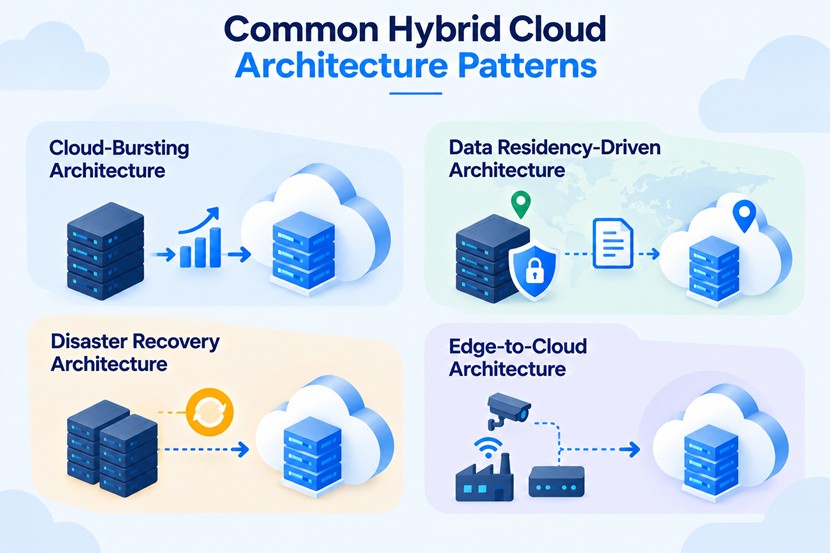
Not every hybrid cloud architecture takes the same shape. The right pattern depends on what an organization needs from each environment. However, these patterns are not mutually exclusive.
The most common patterns include:
- Cloud-Bursting Architecture. This type keeps applications primarily on private infrastructure and shifts to the public cloud only when demand exceeds available on-premises capacity. Cloud-bursting suits organizations with predictable baseline demand and occasional spikes, such as seasonal traffic increases.
- Data Residency-Driven Architecture. This pattern places workloads and data according to regulatory or jurisdictional requirements. Sensitive data stays at a specific private site, while less regulated workloads run on public cloud resources elsewhere.
- Disaster Recovery Architecture. This architecture uses the public cloud as a recovery site for workloads that normally run on private infrastructure. Replicating data and maintaining standby capacity in the cloud reduces the cost of maintaining a second physical data center.
- Edge-to-Cloud Architecture. This pattern processes data close to its source, at edge locations, before sending results onward. Relevant output moves to the public cloud or a private data center for further analysis or storage. Edge-to-cloud architecture suits workloads generating large volumes of data with strict latency requirements, such as industrial sensors.
Many hybrid architectures combine two or more of these patterns as workload requirements evolve. For example, a retail company might rely on cloud-bursting architecture for seasonal traffic while running disaster recovery architecture for the same workloads at the same time.
Hybrid Cloud Architecture Tools and Platforms
Virtualization, orchestration, and cross-environment management in a hybrid setup usually run on established platforms, not custom-built connectors. The right combination depends on which components need the most operational support in each environment.
Common categories include:
- Virtualization and container platforms. Platforms such as Nutanix provide the virtualization layer for private infrastructure, while Kubernetes works by orchestrating containerized workloads consistently across private and public environments.
- Hybrid cloud management platforms. Azure Arc provides centralized management and governance for resources across on-premises and other environments, while Google Cloud offers GKE Multi-Cloud and distributed cloud for Kubernetes-based hybrid and multi-cloud deployments.
- Cost management and optimization tools. Platforms such as IBM Turbonomic and HPE Morpheus normalize billing and usage data across environments, which helps teams to track spending by workload.
No single platform in any category covers every hybrid use case on its own. Most organizations combine tools from at least two categories to get full visibility and control across their architecture.
Hybrid Cloud Architecture Design Challenges
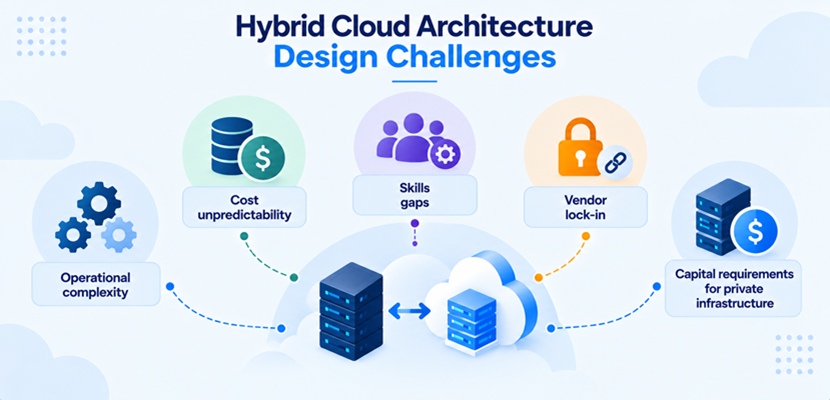
Running two infrastructure models as one system solves real problems, but that combination introduces challenges of its own. Most of these stem from complexity rather than any single technical failure.
Common hybrid cloud challenges include:
- Operational complexity. Managing two infrastructure models at once requires visibility tooling and processes that many organizations take time to develop.
- Cost unpredictability. Public cloud costs scale with usage, while private infrastructure carries fixed costs regardless of how much it is used. Comparing spending across the two requires tracking cost by workload, not just by environment total.
- Skills gaps. Hybrid cloud architecture requires expertise in both traditional infrastructure and public cloud services, a combination not every IT team has trained across.
- Vendor lock-in. Relying on a cloud provider's proprietary services on the public side can make a workload difficult to move elsewhere without significant rework.
- Capital requirements for private infrastructure. Maintaining owned, dedicated hardware for the private side of the architecture requires upfront capital expenditure that some organizations would rather avoid.
These challenges shape how carefully a hybrid architecture needs to be planned, not whether it's worth building.
Best Practices for Hybrid Cloud Architecture
Addressing the challenges above starts with a specific set of actions during design and rollout, not just awareness that the challenges exist. These practices give teams a concrete starting point rather than a list of goals to keep in mind.
Follow these practices when building or refining a hybrid cloud architecture:
- Standardize Infrastructure as Code (IaC). Define infrastructure using code, with tools such as Terraform, across both environments so provisioning stays repeatable and consistent.
- Tag and track costs by workload. Apply consistent tagging across private and public resources so teams can measure spending by workload.
- Automate policy enforcement. Use policy-as-code tools to enforce access controls, encryption standards, and compliance rules automatically.
- Test failover on a schedule. Run planned tests between environments to confirm the recovery path performs as expected before a cloud outage forces the issue.
- Migrate low-risk workloads first. Move non-critical applications into the hybrid architecture before mission-critical systems, to validate connectivity, performance, and governance early.
Following these practices consistently reduces most of the operational risk hybrid architectures introduce, without requiring a larger team or a bigger budget.
Hybrid Cloud Architecture Adoption
Hybrid cloud is not a transitional step toward full public cloud migration. For many organizations, it is the intended long-term architecture, chosen to balance control with scale.
Several factors continue to drive hybrid cloud adoption:
- AI and machine learning workloads. Training large models requires dense, GPU-based computing power. Many organizations pair public cloud AI services with dedicated hardware they control directly, since sustained training runs are often more cost-effective outside the public cloud.
- Unpredictable public cloud costs. Usage-based pricing and data-transfer charges make cloud bills hard to forecast. This pushes steady, high-volume workloads back toward owned or leased infrastructure, while the public cloud absorbs variable demand instead.
Enterprise size also shapes adoption. Larger organizations run paid cloud services at higher rates than smaller ones, though that gap is closing as management tools mature.
Turning Hybrid Cloud Architecture Into a Competitive Advantage
Hybrid cloud works best as a deliberate architecture, not a byproduct of separate decisions made for the private and public sides independently. The organizations that get the most out of it treat portability, governance, and cost tracking as core design requirements, then revisit those choices as workloads, providers, and compliance rules shift.